Graduation Tassel Color Meanings by Field of Study
Graduation Tassel Color Meanings by Field of Study
The graduation tassel colors a graduate wears on commencement day are not arbitrary — they follow a coding system originally codified by the American Council on Education (ACE). Each color signals an academic discipline, and the right tassel reads instantly to faculty, families, and recruiters in the audience. This guide explains the ACE color codes, school-specific variations, and how to spec the right tassel for your degree.
The ACE academic color code
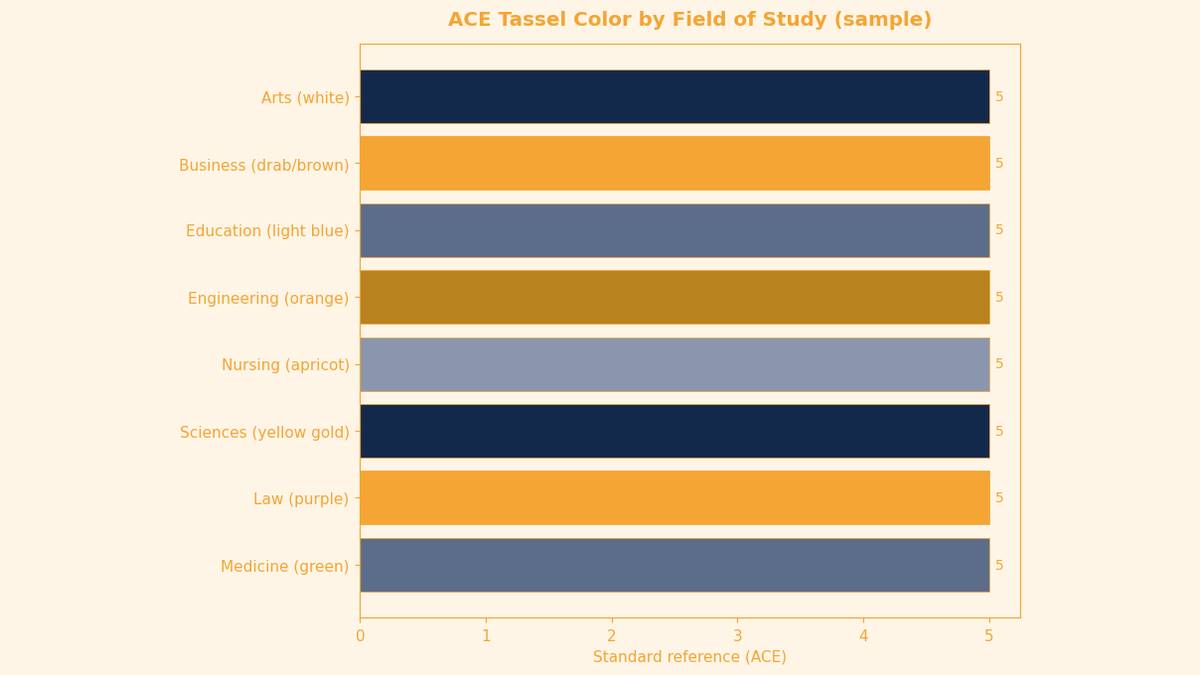
The ACE color code dates to 1893 and assigns a discipline-specific color to each major field of study. Arts wear white. Business wears drab (a muted brown). Education wears light blue. Engineering wears orange. Nursing wears apricot. Sciences wear yellow gold. Law wears purple. Medicine wears green. The code is broadly followed at U.S. universities, though many schools layer school colors over the discipline color for visual identity.
Common discipline-color mappings
Beyond the marquee disciplines, ACE assigns colors across roughly 30 fields. Theology wears scarlet. Music wears pink. Public health wears salmon. Library science wears lemon yellow. Architecture wears violet (distinct from law’s purple, though the two are sometimes confused). Most graduate degree colors carry over from the bachelor’s discipline.
School color overrides
Many universities allow graduates to wear school colors instead of ACE colors. The University of Texas at Austin’s burnt orange, for instance, replaces ACE colors for many fields. Confirm with the campus regalia coordinator before ordering — using ACE colors at a school-color campus (or vice versa) reads as a coordination mistake.
Side-of-cap traditions
Tassel placement on the cap also matters. High school graduates typically start with the tassel on the right side and flip to the left at the moment of degree call. College undergraduates start on the left and stay there. Master’s degree candidates start on the left; doctoral candidates start on the left and the regalia coordinator flips them ceremonially at the moment of conferring.
Single-color, bi-color, and tri-color tassels
Single-color tassels still dominate (~55% of orders). Bi-color tassels — typically blending school colors with the discipline color — make up about 28% of orders and are growing fastest. Tri-color tassels and custom blends serve specialty programs (Latin honors, fraternity-and-sorority graduates, dual-degree candidates).
Bi-color combinations
The most common bi-color blends combine school colors with ACE discipline colors. UCLA blue and gold + ACE engineering orange, for instance, produces a tri-color tassel for an engineering graduate. Confirm bi-color combinations with the awarding department — some require strict ACE adherence; others encourage school-color layering.
Material and weight differences
Polyester silk is the standard tassel thread. Rayon offers a slightly fuller feel at a small price premium. Cotton is rare but used for some traditional and eco-focused orders. Bullion tassels (metallic thread) are reserved for doctoral and exceptional-honor graduates — they weigh nearly twice as much as standard tassels.
Date charms and personalization
Year charms are the most common personalization, typically a brass or silver disc with the graduation year embossed. Custom engraving (name or specialty) costs about $2-$3 per tassel. Multi-charm clusters (year + Greek letters + degree mark) bring the total to $5+ per tassel.
Bulk ordering for student organizations
Order in the 100-250 tier for student organizations and Greek chapters. Per-unit pricing drops sharply between 25 and 100 units, then flattens. Order 8-10 weeks before graduation. Confirm the exact discipline color with each graduate before placing the order — bi-color blends in particular are easy to miscommunicate.
Common ordering mistakes
Two errors come up most often. First, ordering ACE colors when the school uses school colors (or vice versa) — always confirm with the campus regalia coordinator. Second, ordering single-color when the program awards bi-color — the difference reads obviously in cap photos and is hard to fix on graduation day.
Tassel placement on graduation day
The tassel hangs from a central button on the mortarboard, drapes over the edge, and rests on the side designated by the school’s tradition. After the degree call (or conferring moment), graduates flip the tassel to the opposite side. The flip is the visual highlight of the ceremony and the moment most family members capture in photos.
Bottom line
The right graduation tassel colors communicate discipline, honor level, and school affiliation at a glance. Use ACE color codes unless the school overrides with school colors. Confirm bi-color blends with the awarding department. Order 8-10 weeks before graduation, in the 100-unit tier for student organizations, and your graduates will walk in tassels that read correctly to every audience in the room.
Ready to design your graduation tassels? Use our tassel builder, browse stock colors, or read the companion guide on tassel length and weight specs.