Graduation Tassel Colors by Degree: A Reference Guide
Graduation Tassel Colors by Degree: A Reference Guide
That small tassel swinging from a graduation cap carries more meaning than most people realize. Graduation tassel colors are part of a long academic tradition in which each color signals a field of study, a degree level, or an institution, so a glance across a commencement crowd can tell you who studied science, who studied the arts, and who earned an advanced degree. If you are ordering tassels for a school or choosing your own, understanding this color language helps you get it right and appreciate the symbolism behind the swing from right to left.
This reference guide explains how graduation tassel colors map to degrees and disciplines, why the conventions exist, and how schools actually order them, so you can choose colors that are both correct and meaningful.
Where tassel color conventions come from
The color system traces back to academic costume codes that assigned specific hues to fields of study, the same tradition behind the colored velvet on doctoral hoods. Over time, schools adapted these into tassel colors so a graduate’s discipline could be read at a glance. The conventions are widely shared but not absolutely uniform: individual institutions set their own official palettes, and honor societies add their own colors on top. Treat the common associations as a strong starting point, then confirm your specific school’s rules.
Discipline colors at a glance
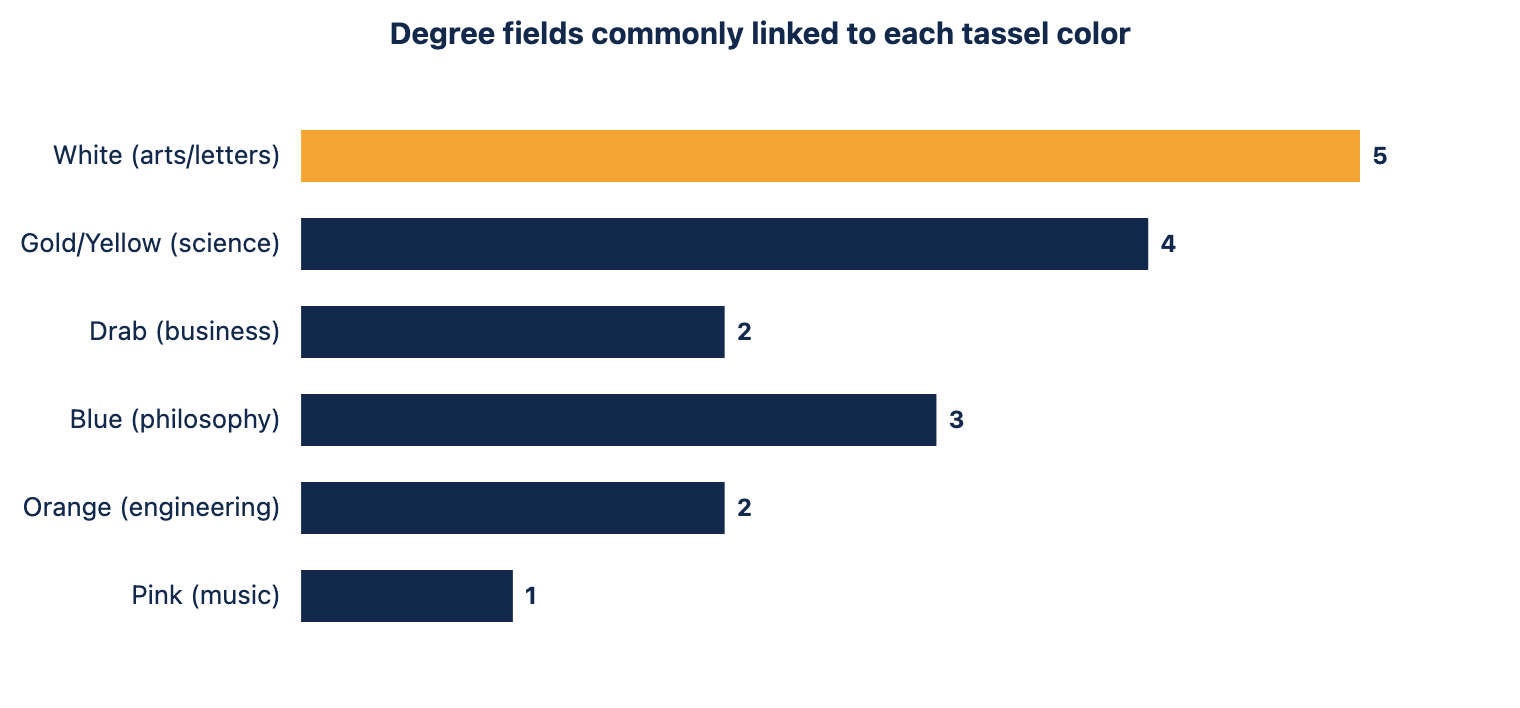
Some associations are especially well established. White traditionally represents arts, letters, and humanities; golden yellow marks the sciences; various shades signal fields like education, business, engineering, nursing, and law. Because a single color can be linked to more than one related field, and because schools vary, the chart above shows how many common fields cluster under each color rather than presenting a single rigid key. The point is directional: color communicates discipline, and the more common the color, the more fields it tends to cover.
Degree level and school colors
Color is not the only variable. Many high schools simply use their school colors for every graduate, sometimes splitting a two-color tassel to represent the institution rather than a discipline. Colleges more often use discipline colors, and graduate programs may layer in their own conventions. Doctoral candidates frequently wear distinctive gold or metallic tassels to mark the highest degree. When ordering for a mixed ceremony, mapping out which groups get which colors in advance prevents a scramble the week before.
How schools order tassels
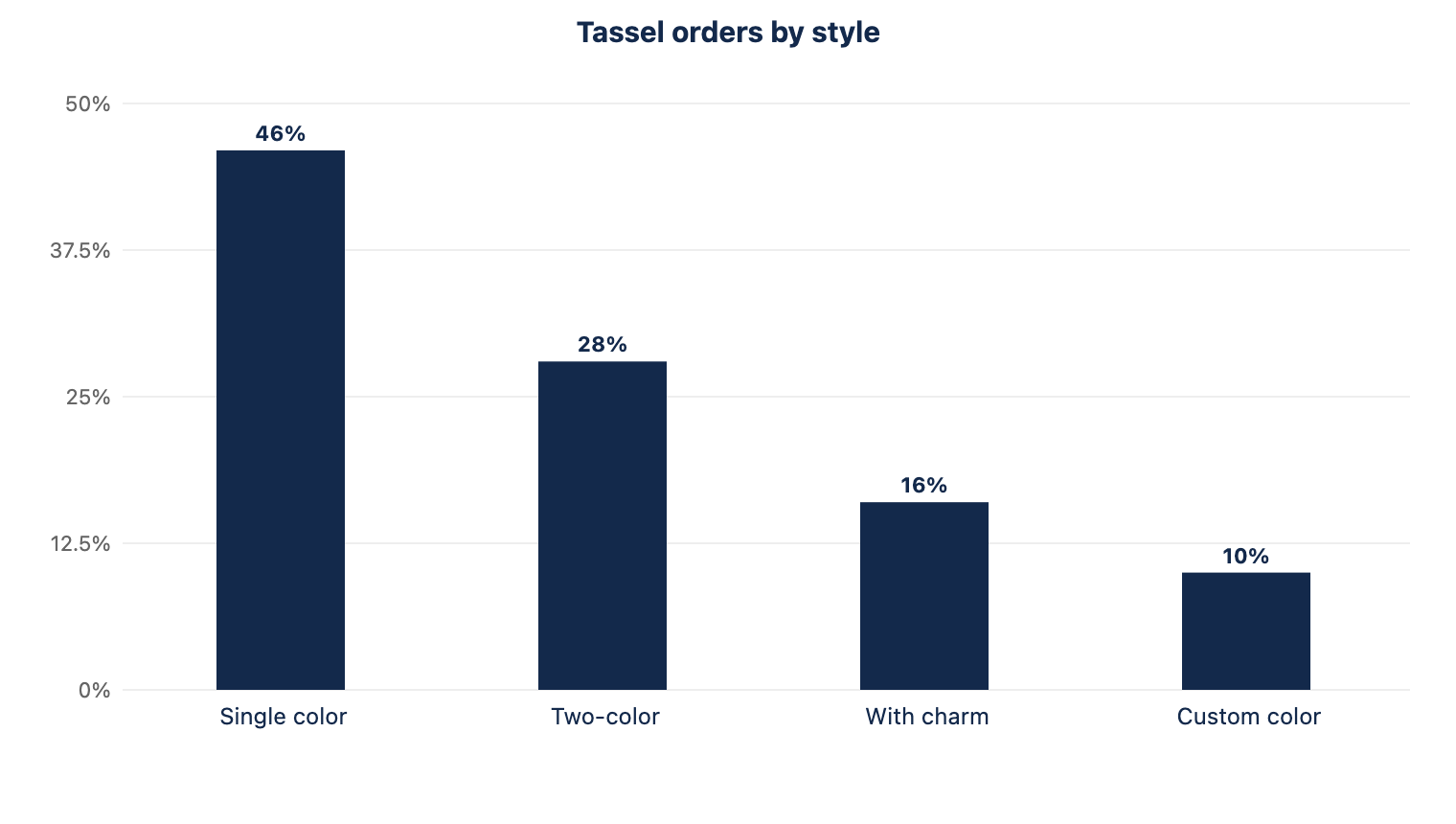
In practice, orders fall into a few patterns. Single-color tassels in school or discipline colors are the most common and the most economical. Two-color twisted tassels represent a school with two official colors, or a graduate spanning two honors. A growing share of orders add a class-year charm or signet, and some schools request fully custom colors to match a specific brand. The mix above reflects what a typical school buyer selects each spring, with single and two-color styles still dominating.
| Style | Represents | Best for |
|---|---|---|
| Single color | One discipline or school color | Most graduates; lowest cost |
| Two-color twist | Two school colors or honors | Schools with dual colors |
| With year charm | Class year as keepsake | Milestone classes |
| Custom color | Exact brand match | Private schools, academies |
Two-color and reversible tassels
Schools with two official colors often choose a two-color twisted tassel that braids both shades together, an elegant way to represent the institution rather than a single discipline. Reversible tassels take this further, letting a graduate show one color during the ceremony and flip to another afterward, or coordinate with different events. When specifying a two-color tassel, decide the ratio and twist you want, since an even split reads differently from a dominant-plus-accent combination. A quick sample confirms the braid looks balanced before you commit to a full class.
Tassels as a lasting keepsake
Part of why color accuracy is worth the effort is that tassels outlive the ceremony by years. They hang from rear-view mirrors, sit in memory boxes, and get passed between siblings, so the color a graduate wore keeps telling its story long after the diploma is framed. Treating the tassel as a keepsake from the start, choosing correct colors and solid construction, means that little object represents the achievement faithfully for as long as it is kept.
Ordering for mixed ceremonies
Large ceremonies often combine graduates from several disciplines or degree levels, each calling for a different color. The simplest approach is to build a clear map, listing each group, its color, and its headcount, before placing a single consolidated order. Ordering everything together secures the best per-unit price and guarantees consistent quality across groups, while a shared spreadsheet prevents the common mistake of a department being forgotten until the final week. Confirm the map with each program lead so no group arrives on stage in the wrong color.
Getting the color exactly right
Because color carries meaning, accuracy matters more here than in most custom products. A tassel that reads slightly too green or too blue can imply a different discipline than intended, and mismatched shades across a graduating class look careless in photos. Always order against a defined color standard, request a sample when matching a specific brand color, and keep a record of the exact shade so future years match. Consistency across classes is part of what makes a school’s regalia look polished and intentional.
The right-to-left tradition
One detail worth knowing: graduates traditionally wear the tassel on the right side of the cap and move it to the left once their degree is conferred, the small ceremonial gesture that marks the transition. It is a nice touch to mention in ceremony instructions, and it reminds everyone that the tassel is not just decoration but a symbol with its own ritual.
Quality and construction
A good tassel is full and evenly cut, with a secure crown or button at the top and strands that hang straight rather than tangling. Cheap tassels look thin and fray quickly, which shows in close-up stage photos and disappoints graduates who want to keep them. Since tassels are inexpensive per unit, the small step up to a fuller, well-made tassel is almost always worth it, especially when it will hang from a rear-view mirror for years afterward as a keepsake.
Bottom line
Understanding graduation tassel colors turns an ordering task into an easy, meaningful decision: color signals discipline, degree level, or school; conventions are a strong guide but always confirmed against your institution’s rules; and accuracy and quality make the whole class look intentional. Map your colors, confirm your shades, and choose a well-made tassel your graduates will keep.
Order tassels in the right colors
Tell us your disciplines, school colors, and quantities and we will match shades precisely and spec quality tassels for your class.
Get a QuoteHome · About · Buying guides · Companion guide: tassel charms for schools