How to Attach a Graduation Tassel to a Cap (and Make Sure It Fits)
Ordering custom tassels is the easy part. The morning of the ceremony, someone still has to get every tassel onto every cap so it sits straight, holds through the walk, and flips cleanly when the moment comes. If your school buys tassels separately from caps, or reuses caps from year to year, there is also a quieter question to answer first: will the tassel you ordered actually fit the caps you have? This guide covers both, the physical attachment and the fit, so a class order does not turn into a scramble at the gym door.
What actually holds the tassel on
A graduation cap, the flat mortarboard, has a small fabric-covered button at the exact center of the top. Every standard tassel ends in a loop, and that loop is what does the work: it slips over the button and cinches down so the tassel hangs from the middle of the board. There is no glue, no pin, and no sewing involved in the standard setup. The button and loop are a matched pair by long convention, which is why most tassels and most caps simply work together.
The loop is usually a short braided or knotted length, sometimes with a little elastic, sized to stretch over a button and then hold snug. When people say a tassel “won’t stay on,” the culprit is almost always a loop that is too loose for a small button or a button that has flattened with age. Knowing that the loop is the whole mechanism tells you exactly what to check when you evaluate a sample.
Attaching it, step by step
Start with the cap oriented correctly, because the tassel goes on after the cap is understood, not before. Find the center button on top of the mortarboard. Open the tassel’s loop with two fingers and pass it over the button until the loop seats at the base of the button, against the board. Give the tassel a gentle tug straight down; it should resist and stay put rather than sliding back off. If the loop feels loose, a second pass or a small twist of the loop before seating it will tighten the hold without damaging anything.
Let the tassel hang freely off one side so the strands fall in a single clean column rather than fanning out. Before the ceremony the tassel typically rests on the right, and it is moved to the left at the moment of graduating, though schools set their own convention. The mechanics are the same either way: the loop stays on the button and only the hanging strands switch sides, so there is no need to remove and reattach anything mid-ceremony.
Will your tassel fit your caps?
This is the part worth checking before you commit a large custom order, especially if the tassels and caps come from different sources or different years. Buttons vary slightly in diameter and height, and a loop that is generous will fit almost anything while a tight, non-elastic loop can fight a larger button. The safe move is to order one sample tassel and test it on an actual cap from your inventory before the full run prints. Confirm the loop passes over the button, seats fully, and holds when tugged.
If you are reusing older caps, inspect the buttons; a crushed or partially detached button will not grip a loop reliably, and it is far cheaper to replace a few caps than to discover the problem on ceremony morning. When you cannot test against the real caps, tell your supplier what caps you are pairing with and ask for a loop sized to standard buttons, which is the most common configuration by a wide margin.
Length and where it hangs
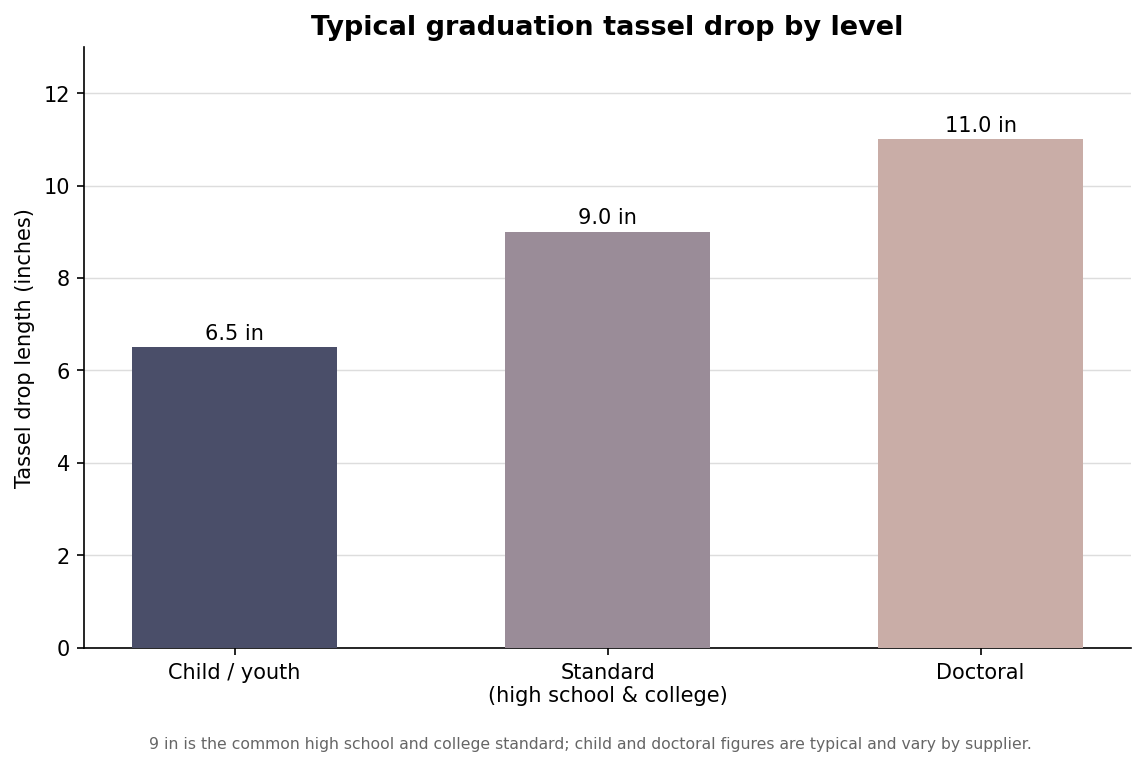
Tassel length is standardized enough to plan around. The common high school and college tassel has a nine-inch drop, with child and youth versions shorter and doctoral tassels longer. The chart below shows those typical drops side by side, which matters when you are ordering for mixed groups or want a proportion that looks right on younger graduates.
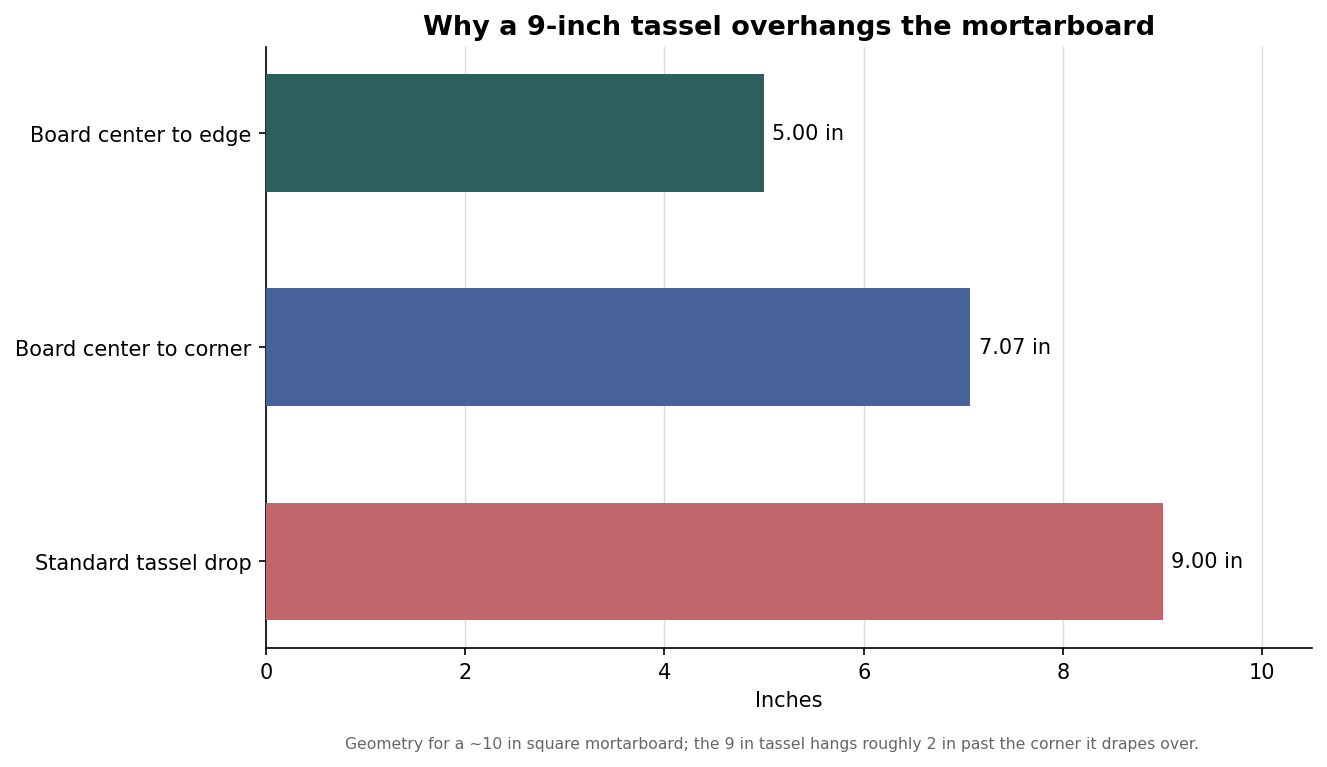
Length also explains a question people ask when they first put a cap on: why does the tassel hang so far past the board? A standard mortarboard is roughly ten inches square, so the distance from the center button to a corner is only about seven inches. A nine-inch tassel is longer than that, which is by design; it clears the corner and hangs a couple of inches below the edge where it is visible and easy to flip. The geometry is laid out below.
Keeping it secure and tangle-free on the day
Two small habits prevent almost every ceremony-day tassel problem. First, seat every loop firmly and test each one with a downward tug as you assemble caps, rather than trusting that a loop draped over a button will hold; a loop that only rests on top can lift off during the walk. Second, store and transport tassels hanging or laid flat rather than bagged in a pile, because the strands kink and knot under their own weight when crushed together. If strands do bunch, running them gently between your fingers or a light steam settles them back into a column.
For a class order, always include a few spare tassels beyond your headcount. Losses and last-minute additions are routine, and a matching spare on hand beats an odd tassel or an empty button in the class photo. Get the fit confirmed with a sample, seat every loop properly, plan the length to suit your graduates, and the tassels will do exactly what they are supposed to do at the one moment everyone is watching.