Graduation Tassel Materials: Polyester, Rayon, and Bullion Compared
Two tassels can look identical in a product photo and feel completely different in your hand. One drapes with a soft, liquid sheen; the other is stiff, dull, and already fraying at the band. The difference is almost always the material. When you are ordering a handful of tassels for one ceremony, fiber choice barely matters. When you are placing a bulk order for a whole class, or choosing a tassel a graduate will keep in a shadow box for decades, it is worth knowing what you are actually buying. This is a look at the three materials you will realistically choose between, what each does well, and how to judge quality no matter which you pick.
The three materials you will actually choose between
Despite the range of listings online, graduation tassels come down to three fiber families. Polyester is the budget-friendly, durable workhorse that dominates high school and college orders. Rayon – often marketed as a silky tassel – trades a little durability for a richer sheen and a heavier, more graceful drape. Metallic bullion, made from gold or silver bullion wire, is the formal option reserved mostly for master’s and doctoral regalia. Many mid-range tassels are actually a poly-rayon blend that splits the difference, aiming for rayon’s look at closer to polyester’s price. Everything else – color count, year charm, custom crown – sits on top of that base material choice.
Polyester: the practical default
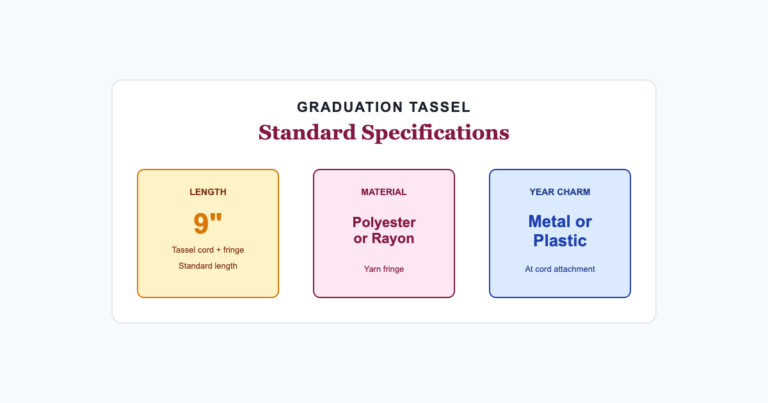
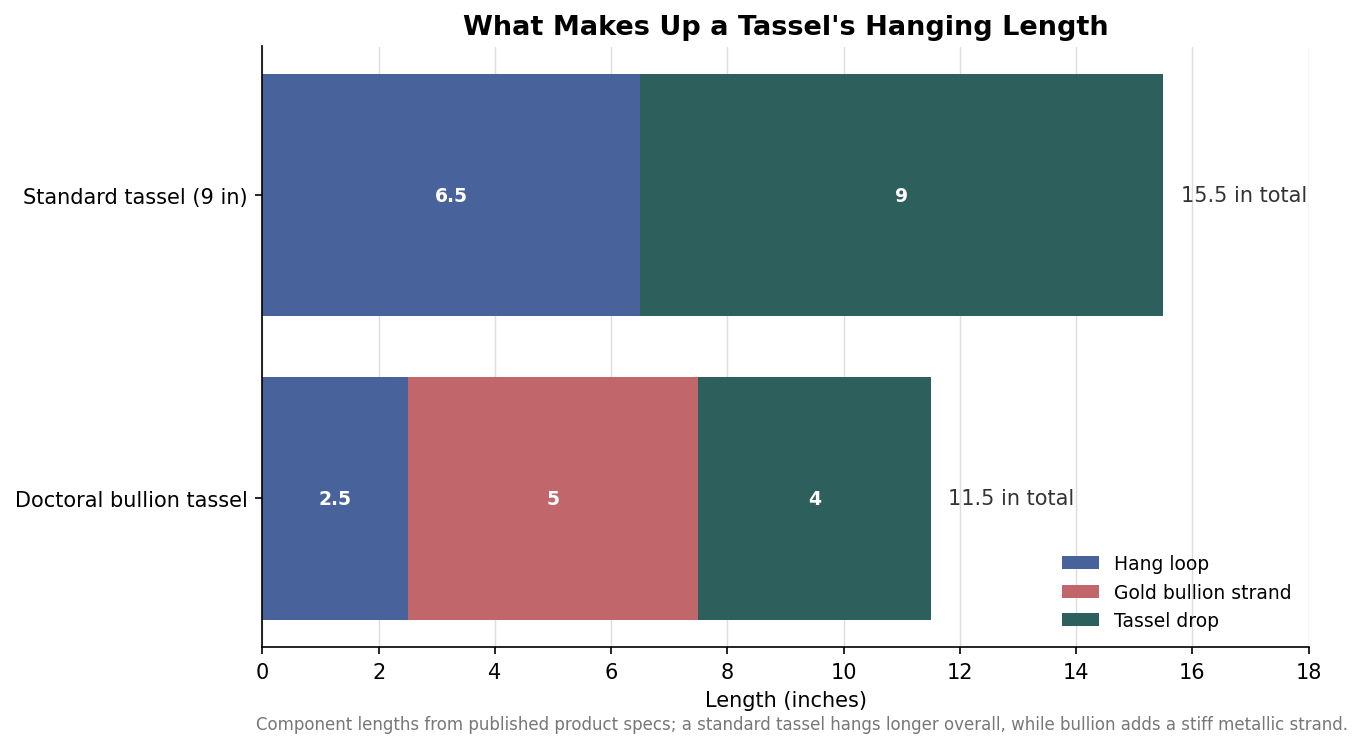
A typical polyester graduation tassel runs about 9 inches long in the strands, hangs from a loop of roughly 6 to 6.5 inches, and is built from around 65 individual strands bound at a crown. That construction is why polyester wins most bulk orders: it holds vivid color, resists fading, and shrugs off a light rain far better than natural-fiber alternatives, so a class order photographs consistently even if the ceremony moves outdoors. The honest trade-off, in the words of one supplier, is that polyester “can sometimes lack the rich sheen and soft feel of higher-end materials.” Under bright ceremony lighting most people never notice, but held next to a rayon tassel the difference in luster is visible.
For schools ordering hundreds of units in a single spirit color, polyester is usually the right call. It is the least expensive per unit, the most forgiving of weather and handling, and consistent enough across a large run that no graduate ends up with an obviously duller tassel than the person beside them.
Rayon and silky tassels: sheen and drape
Rayon is what people picture when they imagine a premium tassel. It carries “a beautiful, silk-like sheen that catches the light” and has “a heavier, more pleasant weight, which helps the tassel hang straight and move gracefully.” That weight is the underrated part: a light polyester tassel can flip and tangle, while a heavier rayon one settles and swings cleanly, which reads better in photos and video. The trade-off is care. Rayon’s richer dyes can be more sensitive to moisture, so a rayon tassel caught in real rain is more likely to show color movement than a polyester one. For an indoor ceremony or a keepsake tassel that will live in a frame, rayon’s look is worth the small premium. For an outdoor stadium ceremony with uncertain weather, polyester is the safer bet.
Bullion and metallic tassels: built for advanced degrees
Metallic bullion tassels are a different object entirely. Made from gold (or silver) bullion wire rather than soft thread, they are stiffer, more sculptural, and heavier for their size. They are also shorter overall than a standard tassel – a typical academic bullion tassel measures about 11.5 inches total, made up of a 5-inch gold strand, a 4-inch tassel, and a 2.5-inch loop – and they usually come attached permanently to the top of a four-, six-, or eight-sided tam rather than clipping to a flat mortarboard. That is why you see them almost exclusively at master’s and doctoral ceremonies. The chart below breaks down how that length is distributed compared with a standard tassel, which actually hangs longer overall because its soft strands drop farther.
If you are outfitting an advanced-degree program, bullion is the expected look and there is little reason to substitute. If you are ordering for high school or an undergraduate class, bullion is overkill – the stiffness and the tam attachment do not suit a standard cap, and the cost is higher for no ceremonial benefit.
What price tells you, and what it does not
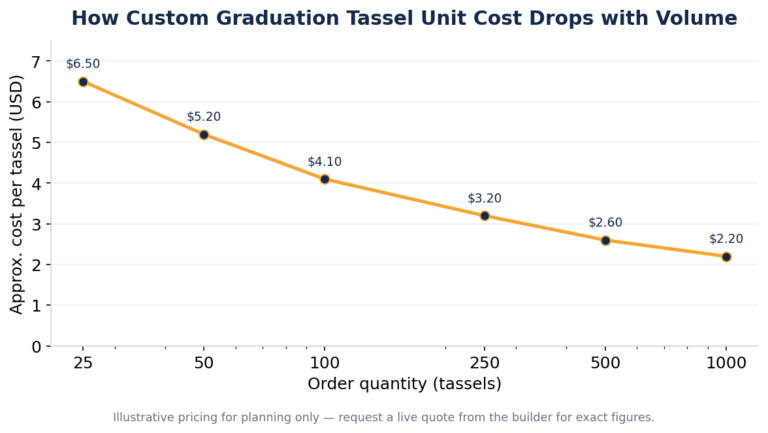
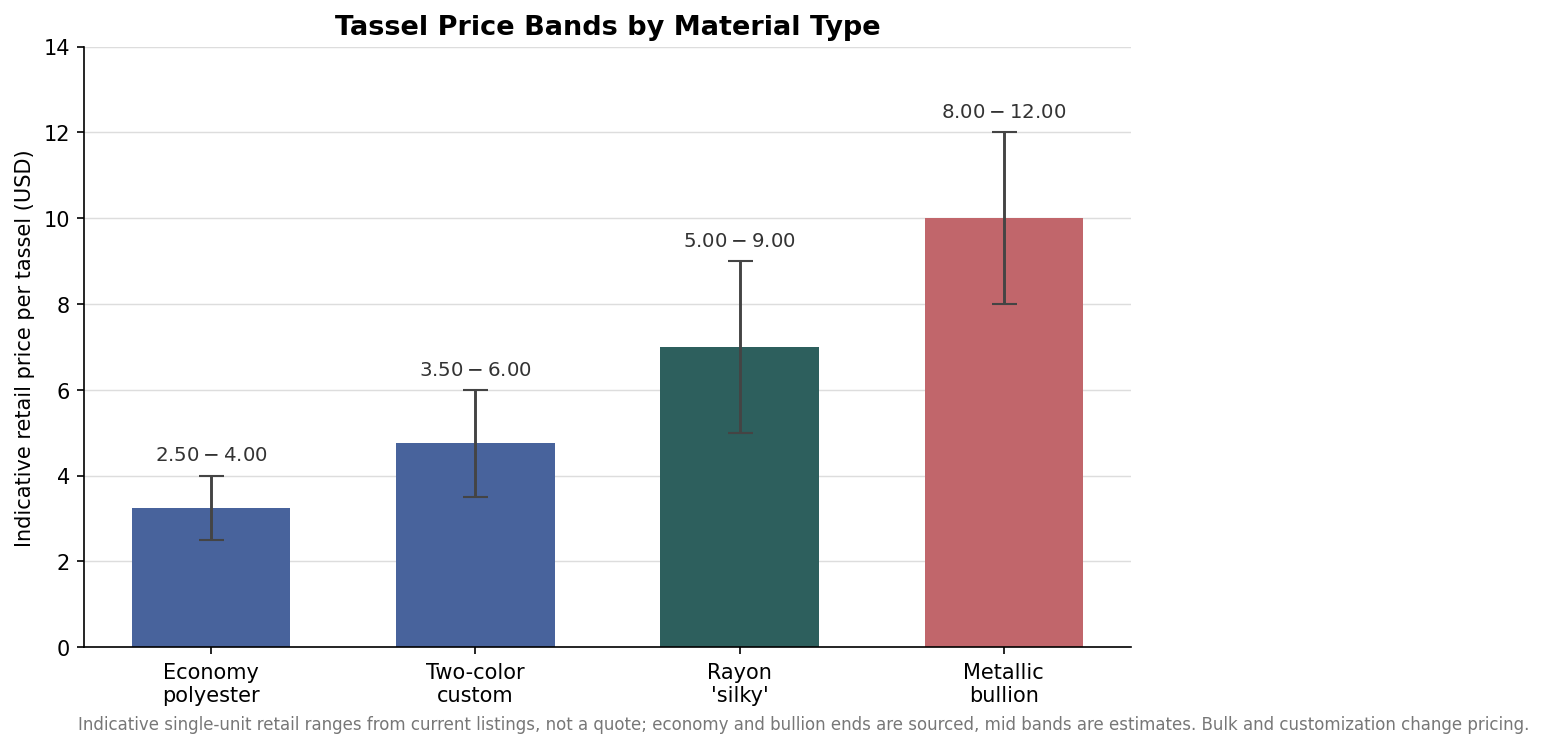
Material is the single biggest driver of unit price. Economy polyester tassels commonly list in the range of about $2.50 to $4 each, with poly-rayon blends and two-color custom versions running a little higher, rayon silky tassels landing higher still, and metallic bullion typically the most expensive at roughly $8 to $12 per unit. The chart below shows those indicative bands; treat the economy and bullion ends as grounded in current listings and the middle bands as estimates, since custom colors and bulk pricing move every number.
Price alone is a weak proxy for quality. A cheap tassel can be perfectly well made, and an expensive one can be sloppily assembled. What actually separates a tassel that survives being handled at a ceremony from one that sheds strands is construction, not fiber cost – which is where your inspection should focus once you have settled on a material.
How to judge construction quality, whatever the fiber
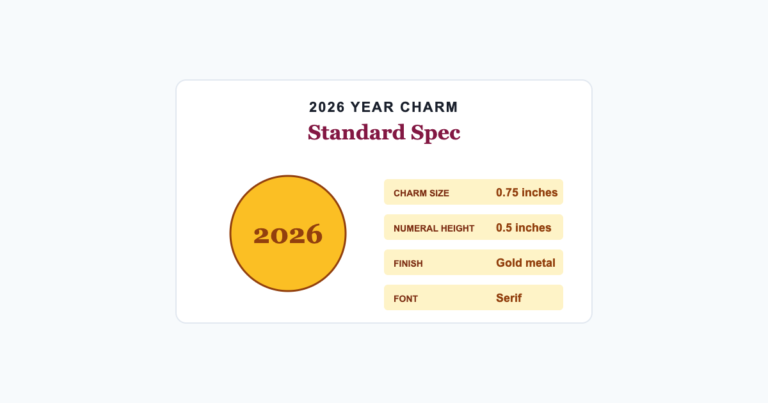
Three details tell you most of what you need to know. First, look for a dense body: a quality tassel has a generous strand count that creates a full, substantial look, while a thin, stringy tassel signals a corner was cut. Second, check the band and clasp at the top – the wrap that gathers the strands should be tightly wound and glued solid, not loose enough to let strands slip out after a few days of handling. A gold-plated copper clasp that hooks cleanly onto the cap button is a good sign; a flimsy bent-wire attachment is not. Third, inspect the year charm: it should hang from a sturdy metal ring, not a thin twist of wire that will straighten and drop the charm the first time it snags. On a keepsake that a graduate keeps for decades, that little ring is often the first thing to fail.
Put those together and the decision gets simple. Choose polyester for large outdoor or weather-exposed orders where consistency and durability matter most, rayon for indoor ceremonies and keepsakes where sheen and drape are worth a small premium, and bullion only for the advanced-degree regalia it was designed for. Then, regardless of which you pick, hold one sample before you commit the full order and check the body, the band, and the charm ring. The material sets the ceiling on how a tassel looks; the construction decides whether it still looks that way when the graduate pulls it out of a drawer years later.